Chasing Light With the 2027 Nissan Ariya
The first indication that something unusual was about to happen came from Matt Collyer, owner and operator of MorningMeets.
His text was brief:
“Be by your phone. A call is coming your way, and I suggest you pick it up.”
Naturally, I spent the next 25 minutes staring at my phone as though looking away might somehow cancel the opportunity entirely.
Eventually, the call came through.
On the other end was Keval Raja, Senior Planner and Marketing Communications Lead at Nissan Canada. He introduced himself, explained that he had become familiar with my photography through my coverage of MorningMeets, and told me he had an opportunity he wanted to present.
A pre-production 2027 Nissan Ariya was travelling to Canada directly from Japan as part of its initial global press tour. According to Keval, it was the only fit-and-finished example of the refreshed model in the world at that moment.
And he wanted me to photograph it for Nissan Canada.
Specifically me.
That took a moment to process.
There was, of course, one small detail: the Ariya would only be in Ontario briefly. It had to continue its press tour and leave for the next country that same evening. I would have approximately three hours with it before it needed to be returned.
Three hours?
I have photographed full vehicle galleries after being given 20 minutes with a car. Thanks again, as always, Jon.
Three hours sounded luxurious.
Then Keval mentioned that the Ariya would arrive at Nissan Canada headquarters the following morning.
The call took place at 2:58 p.m. on June 8. We planned to begin shooting at 11 a.m. on June 9.
Less than 24 hours to prepare.
Let’s make some art, baby.
Planning Around a Car I Had Never Seen
The Ariya was entirely unreleased at the time. There was no formal NDA, but there was a clear understanding that the vehicle’s movements and schedule were to remain private.
Nissan Canada would also be given the opportunity to publish the photographs first, with my account included as a collaborator on the post.
That was an easy decision. I was proud to have my name and work presented beside a brand like Nissan Canada. I certainly was not going to throw away the opportunity because I needed to post the images five minutes earlier.
The creative brief itself was refreshingly open.
There was no shot list, required image count, mood board or collection of references. Keval had seen enough of my MorningMeets work to understand how I photographed vehicles and what my typical deliverables looked like.
His words, not mine.
To me, that trust meant I needed to create my cleanest and most marketable automotive gallery to date. This was my first opportunity to make an impression on Nissan Canada directly, and I had no intention of treating it casually.
The only specific request was to attempt to photograph the Ariya near a charging station or actively charging, helping communicate that it was an electric vehicle.
Fortunately, the location I had in mind already had chargers nearby.
What I wanted from the final set was slightly different from the pristine, isolated world vehicles are often placed into for commercial photography. I wanted to show what the Ariya might look like in real life: parked outside a modern residential building, surrounded by greenery and architecture, occupying an environment where someone could realistically encounter it.
The challenge was that I had no real idea what it looked like yet.
There were no readily available photographs of the 2027 model to study. I could look at the previous model year, but I could not properly plan around the updated bodywork, headlights, wheels or proportions.
I knew the vehicle would be white.
That was enough to start.
Finding the Location
Learning the colour immediately brought one location to mind: The Shores in Oakville.
QuietHours had hosted its inaugural meet in the surrounding area only a week earlier, so I had recently spent time examining the neighbourhood and mentally collecting possible shooting angles.
The area sits near the Lake Ontario waterfront, with the surrounding block offering a mixture of residential architecture, greenery, lake views and access to downtown Oakville. A newly refurbished apartment complex wraps around part of the block, with a private driveway running between its modern façade and landscaping.
The first time I saw that driveway, I knew there was a shoot there.
The light concrete, repeating balconies, curved architectural lines and carefully maintained greenery created a setting that felt contemporary without looking sterile. It offered several visual directions within a small area, which was important when working with a vehicle that could not simply spend the afternoon travelling between locations.
Once Keval saw the Google Street View screenshots, Nissan approved the plan. He was permitted to drive the Ariya from Nissan Canada headquarters in Mississauga to Oakville for the shoot.
The pieces were falling into place.
My equipment plan was deliberately simple. I used my Sony A7R II, primarily paired with a Tamron 28–75mm zoom, with an 85mm prime available for tighter detail photographs.
Should I own a 70–200mm lens?
Yes.
Do I?
No.
That is part of the reason I continue to appreciate the A7R II’s 42-megapixel sensor. When the subject is sharp, that resolution gives me room to crop while still producing a highly usable final image.
Going into the evening, everything appeared surprisingly manageable. The vehicle was on schedule. The location was selected. My equipment was ready. The forecast suggested heavier cloud cover, but no meaningful rain.
Clouds are hardly a problem for me. Soft, diffused light can be ideal for white paint, reflective bodywork and automotive details.
The rest was up to me.
And, apparently, the weather.
The Weather Arrives With the Car
The morning of June 9 remained mostly consistent with the forecast. The cloud cover was slightly heavier than expected, but there was still no meaningful rain showing.
At approximately 11 a.m., I saw Keval arriving in the Ariya.
The moment I thought, “There he is,” it began to rain.
Not a light mist. Not one of those situations where you debate whether it is technically raining.
It was raining.
My immediate priority became getting my camera out of the weather before the shoot ended through an entirely different form of equipment failure.
The heaviest part only lasted two or three minutes, but it was enough to soak the surroundings and cover the Ariya in water. The rain then faded into a mist before eventually clearing shortly before noon.
Its departure left behind a wet location, a wet vehicle and a completely overcast sky.
So, really, very little evidence that it had ever happened.
Keval was understandably stressed. We had a pre-production vehicle with an international travel schedule, a three-hour shooting window and a commercial gallery to produce. Losing nearly an hour to weather was not part of the brief.
I tried to offer the most useful reassurance I could think of, borrowed from a very smart man who happens to wear green quite often:
“They don’t melt in the rain.”
The rain was a problem, but it was also an opportunity.
Commercial photography does not always happen under ideal circumstances. Schedules change. Light disappears. Weather ignores the forecast. The real test is whether the client can still depend on you when that happens.
I wanted Keval, and Nissan Canada, to know that they could.
Before we could prove anything, however, we needed towels.
Our shoot officially began with Keval and me climbing into the Ariya and heading to the nearest store to find something capable of drying it.
Nothing communicates the glamour of an international automotive press tour quite like urgently purchasing kitchen towels from a local drugstore.
Three Hours Becomes One
By noon, the weather had improved enough that I was comfortable taking the camera back out.
Drying the car was another matter.
Using our newly acquired collection of towels, it took until approximately 12:30 or 12:45 to get the Ariya to a condition we could generously describe as dry.
Our original three-hour session had become little more than an hour.
Within that remaining time, I needed to photograph the exterior and interior at two areas around the location: one near the waterfront and boardwalk, and the other along the apartment complex driveway.
My original plan had been more detail-focused. With the shortened schedule, I adjusted.
Rather than spending too much time perfecting individual details while the car was still holding water in every seam and body line, I prioritized wider environmental photographs. Those images were already central to my idea of showing the Ariya in a believable, real-world setting, and they would allow me to document the full vehicle quickly from several perspectives.
I still photographed the exterior details. I simply kept moving.
There was no time to become overly attached to any single angle. I would establish the composition, check the reflections, make sure the important body lines were readable, capture what I needed and move to the next frame.
The apartment driveway became the strongest part of the location almost immediately.
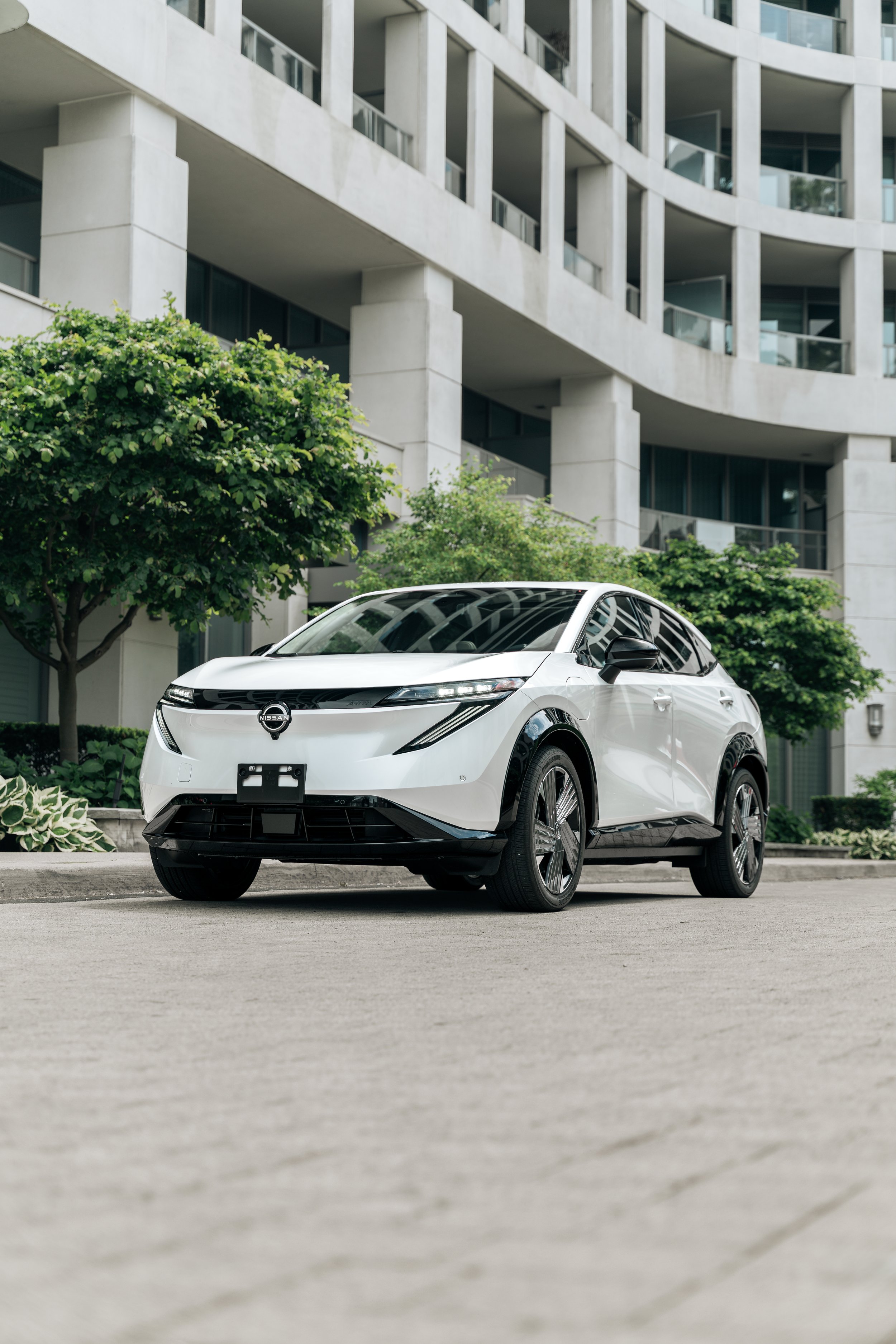
The architecture and the Ariya seemed designed to be photographed together. The building’s curved concrete sections echoed the vehicle’s smooth bodywork, while its repeating columns and balconies contrasted with the sharper angles found in the front lighting and lower trim.
The white paint sat naturally within the setting. Greenery added separation and kept the scene from becoming entirely monochromatic, while the dark windows, wheel arches and lower body treatment gave the car definition against the pale building.
In the finished establishing photograph, the Ariya looks calm and carefully placed beneath soft light.
The frame does not reveal that we had just spent a significant portion of the morning panic-buying towels and checking the sky every few minutes.
Photography is useful that way.
Photographing the Details
One of the first exterior details that stood out to me was the wheel design.
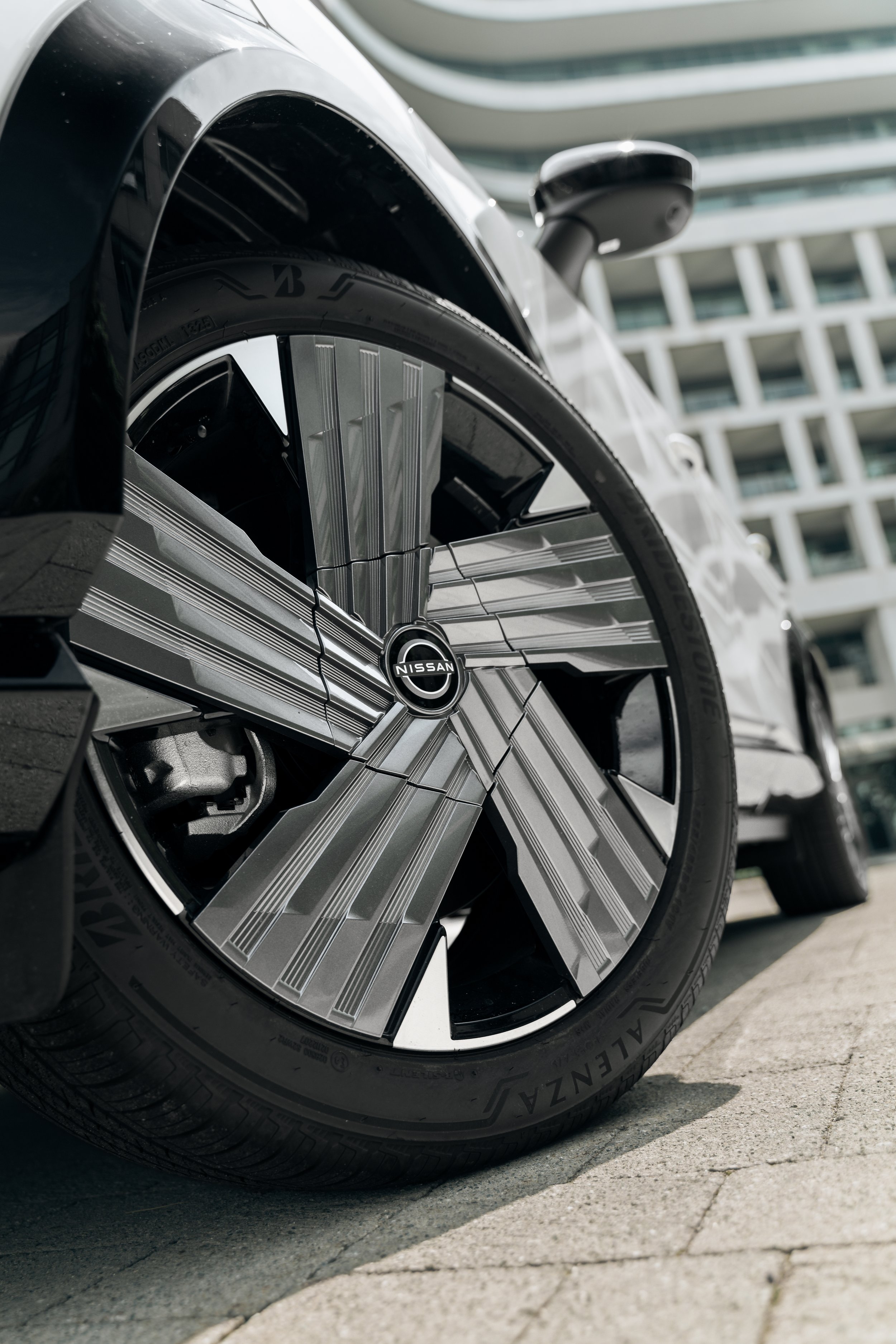
The 20-inch factory wheels feature layered geometric surfaces that change noticeably depending on the angle and direction of the light. For one of the tighter images, I placed the camera extremely low and close to the front wheel, allowing it to dominate the frame while the vehicle and architecture gradually fell out of focus behind it.
When the light briefly became harder, it helped reveal the texture and separation within the wheel’s design. The same direct sunlight that could become difficult across an entire white vehicle became useful when concentrated on one specific detail.
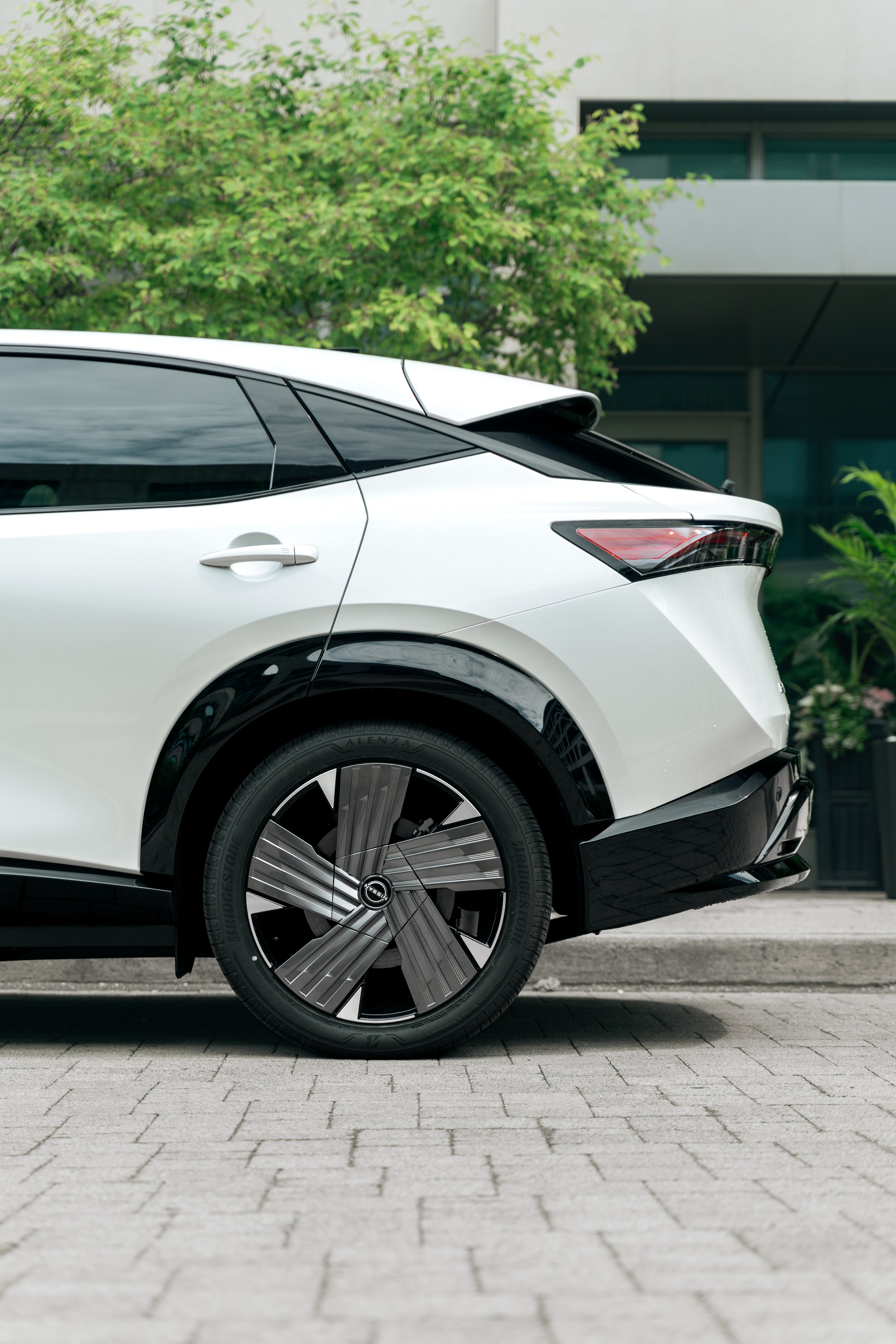
Moving around the rear of the Ariya, I focused on the relationship between the wheel arch, taillight, black window treatment and sloping roofline. A tighter crop of the rear quarter allowed those elements to carry the photograph without relying on the full silhouette or prominent badging.
It is one of the images I appreciate most because of its restraint. The vehicle remains recognizable, but the photograph is primarily about the shapes and surfaces that define it.
Moving Inside
The rain complicated the exterior photography, but the soft light it left behind was nearly perfect for the interior.
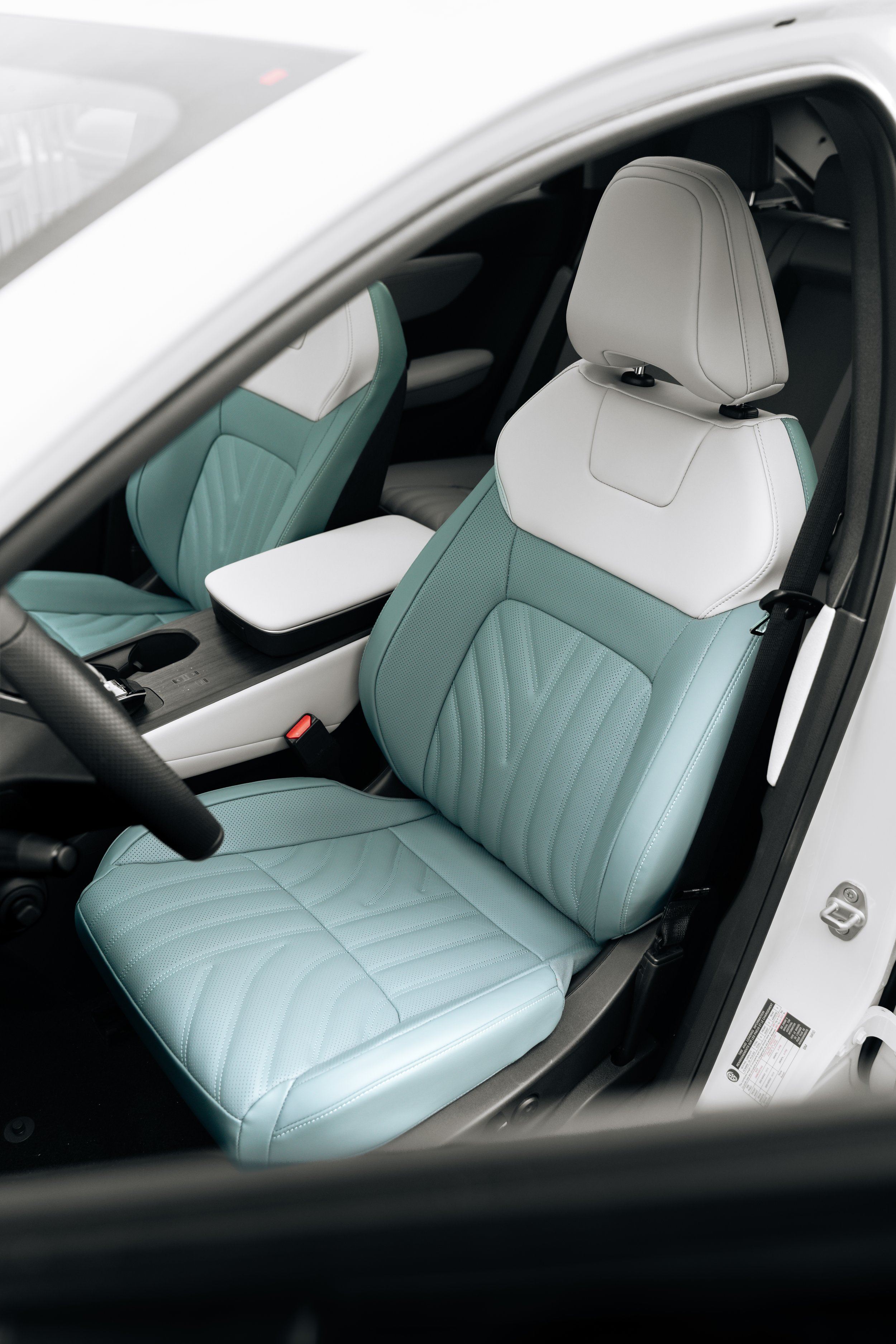
The cabin of the Platinum+ model was immediately impressive. The pale blue-green upholstery, white upper sections, patterned materials and dark trim created a distinctive palette that felt modern without becoming clinical.
For the main interior overview, I photographed from the rear seating area toward the dashboard. The front seats became natural framing devices, directing attention toward the steering wheel, digital displays, centre console and digital rear-view mirror.
Interior automotive photography presents its own collection of problems. There are windows in nearly every direction, screens producing their own light, reflective trim, dark lower surfaces and bright upholstery that can lose detail very quickly.
The refreshed headlights were another immediate focal point. Their thin shape and unusual housing gave the front end a more distinctive expression than the previous model. Nissan describes the refreshed styling as being inspired by “Timeless Japanese Futurism,” and seeing the vehicle in person, that description makes sense.
The lines are smooth but intentional. The front fascia feels simplified without becoming anonymous, and the sharper lighting elements provide contrast against the otherwise fluid shape of the body.
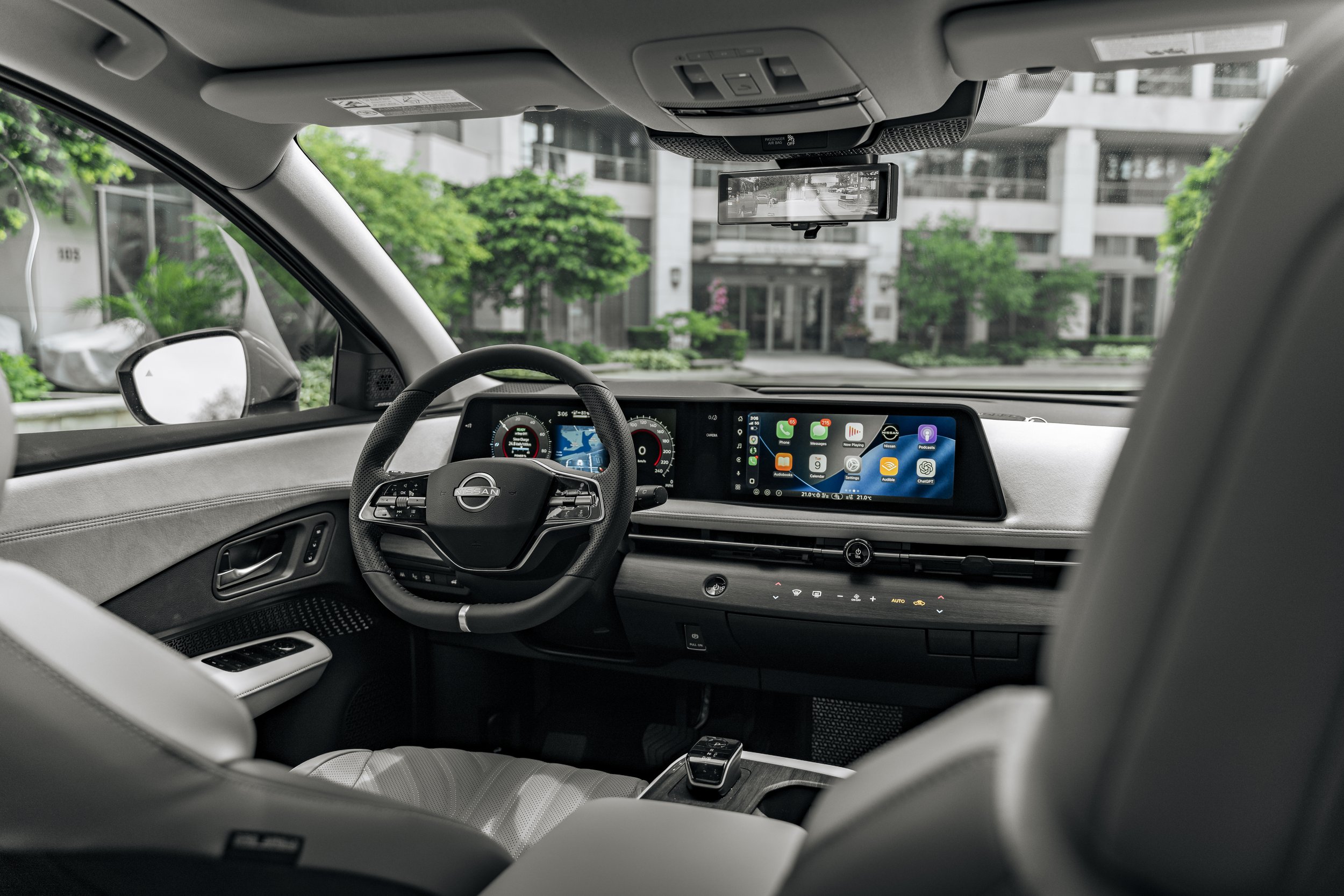
The goal was to keep the technology visible without turning the dashboard into a row of glowing rectangles, while also preserving enough detail through the windshield to connect the cabin to the exterior location.
The overcast conditions helped. Light entered the cabin evenly, reducing glare and allowing the materials to remain visible across the frame.
The remaining droplets on the glass also became a subtle part of the photographs. They are not the subject, but they preserve a trace of what had happened outside.
The weather was still present. It had simply moved to the other side of the window, where it could offer its opinions from a more respectful distance.
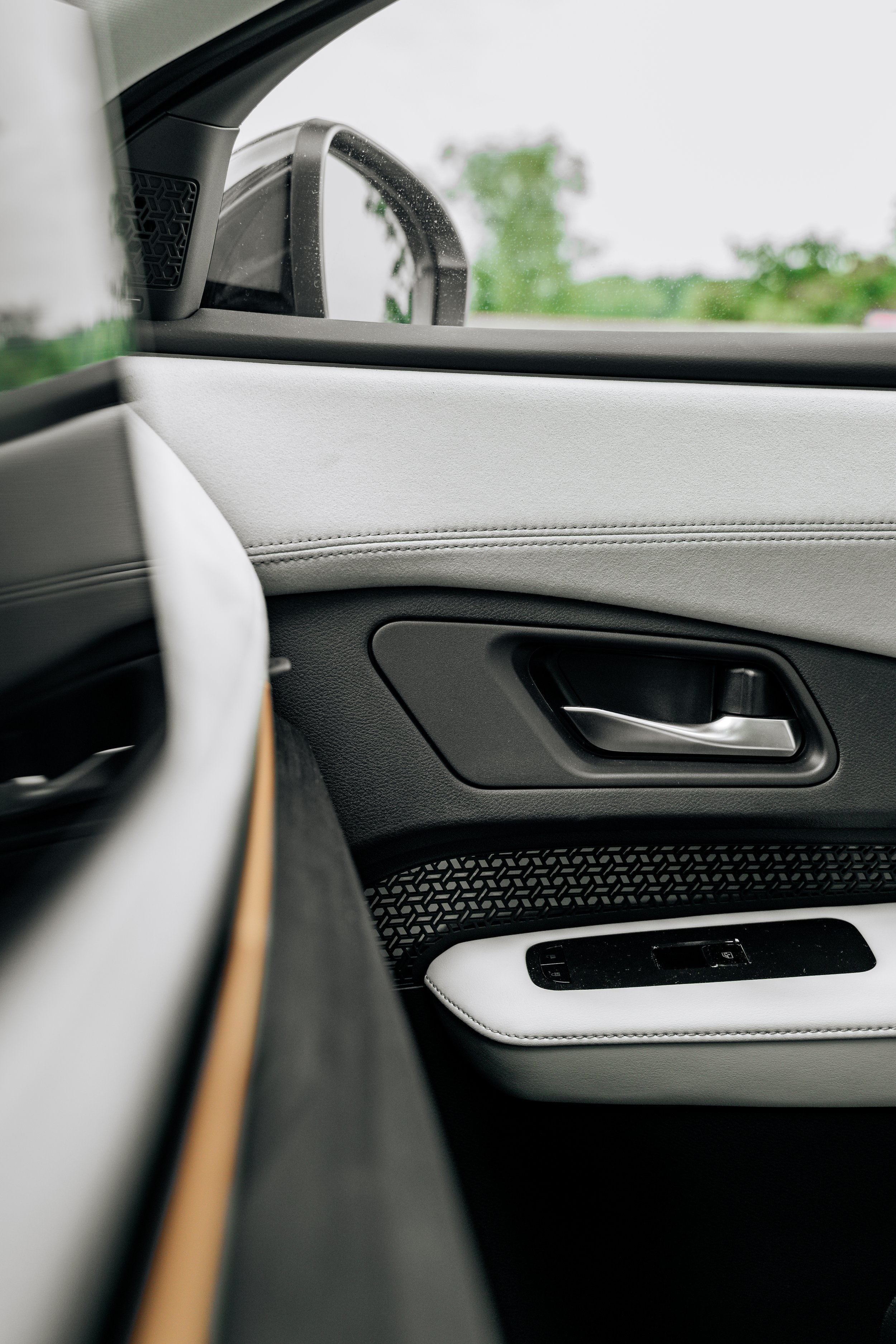
For a tighter interior image, I used the edge of the centre console as a foreground element while focusing on the passenger-side door. The composition moves from the blurred foreground trim to the stitching, handle, patterned surfaces, mirror and soft greenery outside.
Rather than clearing every obstruction from the frame, I used those layers to make the viewer feel seated inside the vehicle.
The front seats deserved their own photograph as well. Their colour and stitching were among the most visually distinctive parts of the cabin. Shooting downward through the open door allowed the driver’s seat to remain dominant while still showing the matching passenger seat, centre armrest and console materials.
After spending much of the morning working around rain, reflections and a steadily shrinking schedule, the seats had the courtesy to remain in one place and look good from nearly every angle.
I appreciated that.
The Ariya in the Real World
My first impression of the 2027 Ariya was that Nissan had created a design language that moved consistently from the exterior into the interior.
The smooth but sharply defined lines felt deliberate. The redesigned front end was more pleasing to my eye than the outgoing version, and the combination of the headlights, wheels and technology-heavy cabin gave the vehicle its own recognizable identity.
More importantly, it felt believable as a vehicle people would actually live with.
I could see families using it for school runs, basketball practice and groceries. I could see it travelling across the country, carrying people through the ordinary experiences that eventually become memories.
It is practical, filled with modern technology, electric and clearly designed with family use in mind.
That was part of what I wanted the wider photographs to communicate.
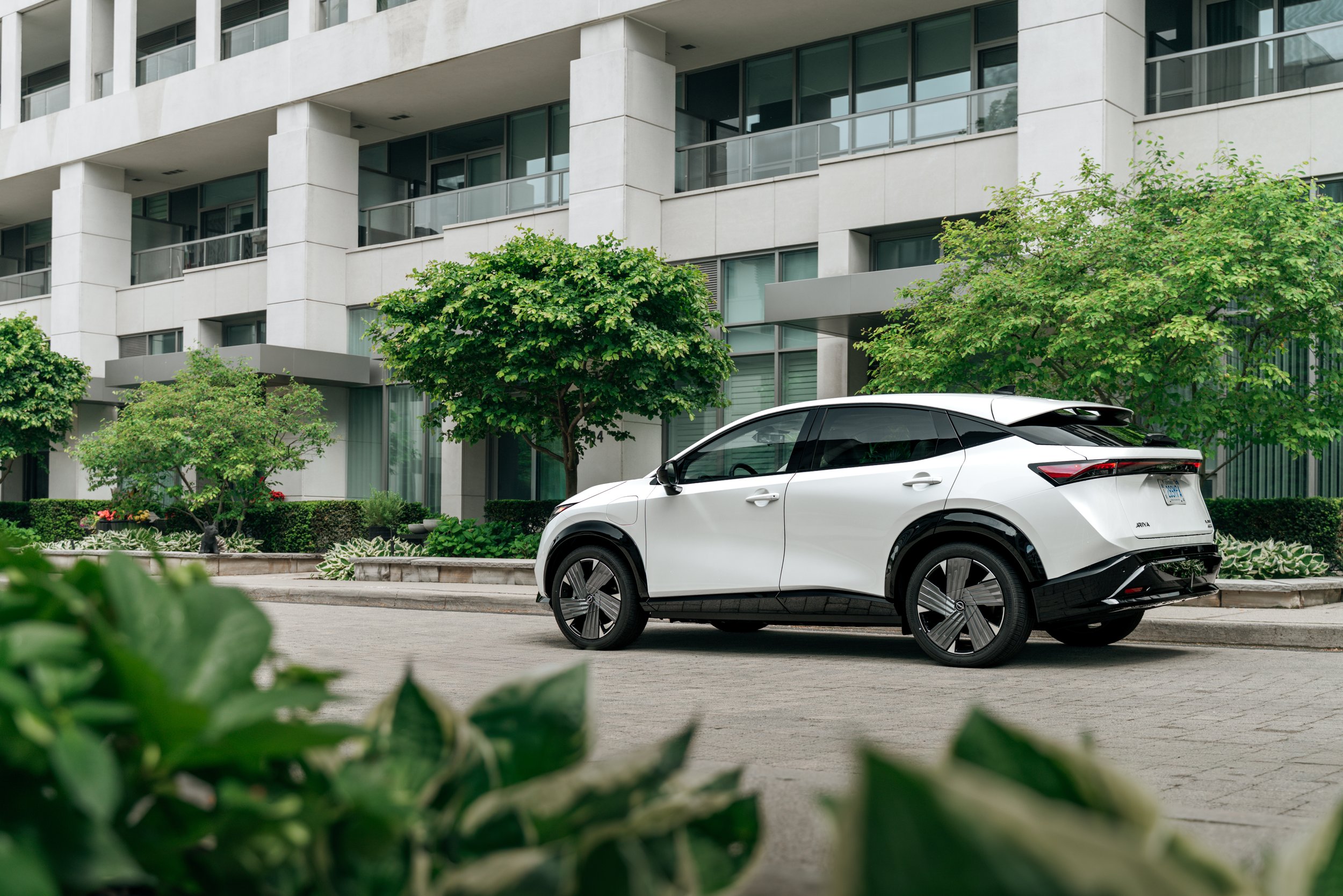
The final environmental image places the Ariya farther into the scene, surrounded by architecture and greenery. The vehicle occupies the right side of the frame, viewed from the rear three-quarter angle, while soft foreground plants create depth across the bottom.
It feels quiet and unhurried.
Again, very considerate of the photograph not to include me repeatedly checking the time.
Seven Photographs
The seven photographs featured with this post are the same images Nissan Canada ultimately selected and licensed to share through its social channels.
Most of their favourites came from the apartment complex driveway, which was the location I had felt most strongly about from the beginning.
The relationship between the architecture and the Ariya became the visual foundation of the gallery. The building helped communicate the car’s modern design while still placing it somewhere believable. The greenery softened the concrete, the overcast light preserved the white paint, and the vehicle looked as though it belonged there.
That had been the goal from the start.
The route we took to reach it was simply more eventful than planned.
What We Pulled Off
Nissan Canada was extremely happy with the final photographs. The response was strong enough that there is interest in continuing to work together more consistently, though I will leave the details there for now.
Looking back, I am proud of more than the images themselves.
The morning could easily have become a write-off. We had an unreleased vehicle with a fixed departure schedule, rain arriving at exactly the wrong moment, an hour lost before the camera properly came out and only a narrow window to photograph the entire car inside and out.
Instead of letting the pressure take over, Keval and I adjusted.
We found towels. We dried the vehicle. We changed the shooting plan. We prioritized the strongest compositions. We kept moving.
By the end of the session, we had created something that both of us could look at and say:
We did that.
The experience reinforced something I have learned repeatedly through automotive photography: preparation matters, but adaptability matters just as much. A strong plan gives you somewhere to begin. It does not guarantee that the day will follow it.
Sometimes the weather arrives with the car.
Sometimes three hours becomes one.
And sometimes, despite all of that, the photographs come together exactly as you hoped they would.
Now I want to do it again.